 Poker Analytics
Pot odds: how much equity do you need to call?
Your opponent bets the river and you're holding a hand that only beats a bluff. Should you call? Pot odds won't tell you whether they're bluffing, but they tell you exactly how often they need to be for the call to make money.
The formula
Say there's 60 in the pot on the river and your opponent bets 30. To call, you put in 30. Once you have, the pot holds 60 + 30 + 30 = 120, and your 30 is a quarter of it.
equity needed = call ÷ (pot + bet + call)
= 30 ÷ (60 + 30 + 30) = 30 ÷ 120 = 25%
That's the whole thing: what you put in, divided by what the pot holds once you've put it in. Win more than 25% of the time and the call makes money. Win less and it loses. At exactly 25% it breaks even.
So where does it come from?
It's the expected value of the call, set to zero. When you call, you either win what's already out there, the pot plus their bet, or you lose your call.
EV = equity × (pot + bet) − (1 − equity) × call
Set the EV to zero, solve for equity, and you get call ÷ (pot + bet + call) back.
You can check it on the example. At 25%, a quarter of the time you win 90 (+22.5 on average), and three quarters of the time you lose 30 (−22.5 on average). Over a lot of rivers, the call comes out at exactly zero.
The price of every common bet size
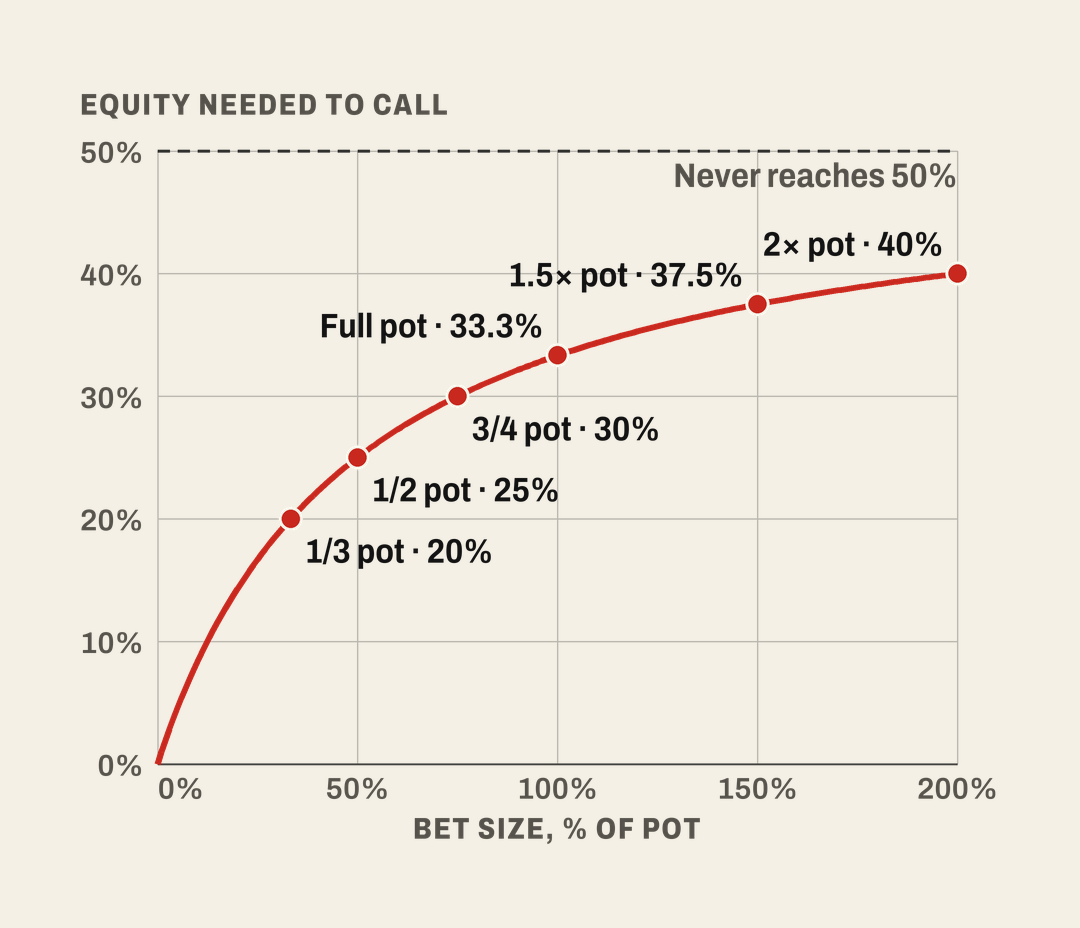
The chart plots that price for every bet size from nothing up to twice the pot. Here are the six points on it, with a pot of 60 so every number stays round:
| Bet size | Bet | Pot after your call | Equity needed | Pot odds |
|---|---|---|---|---|
| 1/3 pot | 20 | 100 | 20% | 4 to 1 |
| 1/2 pot | 30 | 120 | 25% | 3 to 1 |
| 3/4 pot | 45 | 150 | 30% | 2.33 to 1 |
| Full pot | 60 | 180 | 33.3% | 2 to 1 |
| 1.5× pot | 90 | 240 | 37.5% | 1.67 to 1 |
| 2× pot | 120 | 300 | 40% | 1.5 to 1 |
You don't need the pot size at all, only the bet as a fraction of it. With a pot of 1, a bet of b pots means you call b and the pot after your call is 1 + 2b:
equity needed = b ÷ (1 + 2b)
A half-pot bet is b = 0.5, so 0.5 ÷ 2 = 25%. A pot-sized bet is 1 ÷ 3 = 33.3%.
Why does the line flatten?
Since b = 0.5 × (1 + 2b) − 0.5, divide both sides by 1 + 2b:
b ÷ (1 + 2b) = 0.5 − 0.5 ÷ (1 + 2b)
The equity you need is 50% minus a term that shrinks as the bet grows, more and more slowly, without ever reaching zero. So each extra bit of bet raises the price less than the last, and no bet ever asks for 50%.
What pot odds don't tell you
Pot odds give you the price of the call. Whether the call is good depends on your equity against the hands your opponent actually bets like this, and that's the real work: how often is this player bluffing here?
The formula also assumes the betting is over, which is why the river is the cleanest case. On the flop or the turn there are more bets to come, and you won't always see a showdown, so calling at exactly the price isn't really break-even there. What you can win later when you hit (implied odds) and what you can lose later when you hit and they're still ahead (reverse implied odds) move it one way or the other.
And in a raked game, the house takes a slice of the pots you win, so the real price is a little higher than the formula says.
If you'd like an explanation on another topic, just tell us!
Check the calls you made.
Record the hands worth keeping, replay them, and run your equity against a hand or a range with the equity calculator.